

Nvidia’s Chief Executive Officer, Jensen Huang, has revealed that the company is now seeing at least $1 trillion in confirmed and projected demand for its AI infrastructure products through 2027 – a doubling from the roughly $500 billion pipeline disclosed just a year ago.
The figure, shared at Nvidia’s GTC 2026 conference, reflects purchase orders and high-confidence demand for its next-generation platforms, including Blackwell and Rubin, alongside associated networking infrastructure.
Beyond the headline number, the signal is clear: AI infrastructure demand has entered a new phase of scale and certainty.
Huang emphasized that deploying capital at this level requires more than ambition. It requires confidence – that the infrastructure will be utilized, deliver performance at scale, remain cost-effective, and sustain long-term value. In his words, this is no longer experimental infrastructure. It is mission-critical global compute.
A significant share of this demand remains concentrated among hyperscalers, with approximately 60 percent of Nvidia’s business driven by the top five cloud providers. However, even within that group, a growing portion reflects internal AI workloads rather than external cloud services – highlighting the rapid expansion of enterprise-scale AI consumption.

For Africa, the implications are profound.
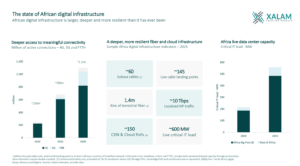
While global markets are committing hundreds of billions – and now trillions – of dollars to AI-ready compute infrastructure, the continent continues to operate with a fraction of global data center capacity. The gap is no longer just about connectivity. It is about compute, capital, and positioning in the next phase of the digital economy.
The question for African markets is no longer whether AI infrastructure demand will materialize.
It already has.
The real question is whether Africa will participate as a builder of that infrastructure – or remain a consumer of it.