
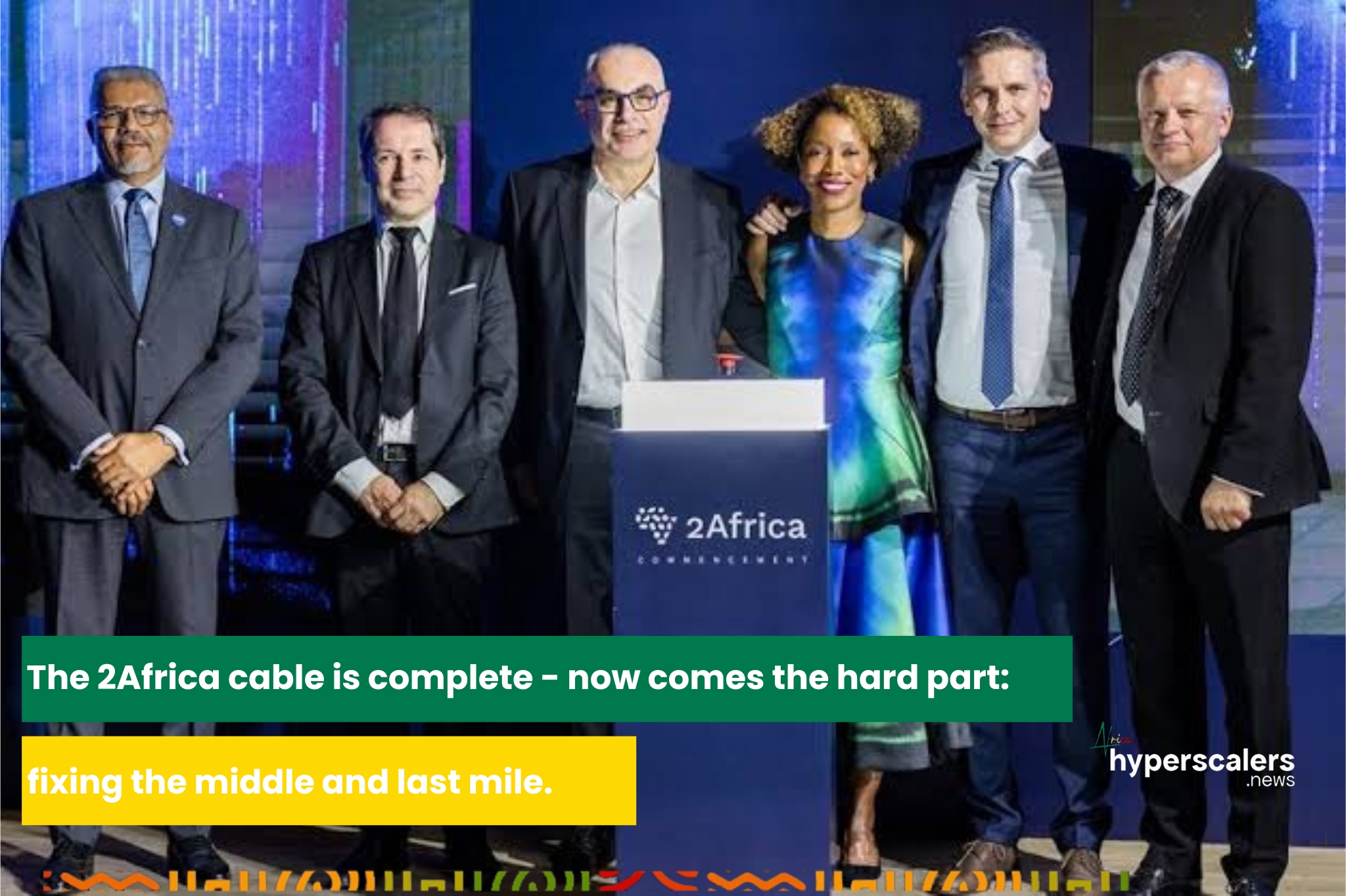
When Meta and its consortium partners confirmed the core completion of the 2Africa subsea cable system, the announcement reverberated far beyond the engineering world. At 45,000 kilometers (inclusive of the 2026 Pearls extension), 2Africa is the longest subsea cable system ever built – an open-access digital highway encircling Africa, linking 33 countries across Europe, Asia, and the continent’s entire coastline. It is, by every measure, a once-in-a-generation infrastructure achievement.
But as industry leaders celebrate the new capacity that will wash up on African shores, a more sobering question hangs over the continent: What good is the world’s largest subsea cable if the data it carries cannot move efficiently inland? The hard part, experts say, begins now.
The 2Africa story is less about fiber pairs and terabits than it is about unprecedented collaboration. The consortium – Meta, Bayobab (MTN Group), center3 (stc), CMI, Orange, Telecom Egypt, Vodafone Group, and WIOCC, with support from Airtel and MainOne (Equinix) – pulled off what no single operator or government could have done alone. More than 50 jurisdictions navigated regulatory clearances, rights-of-way negotiations, and landing-station integration to deliver an open-access system capable of up to 180 Tbps of trunk capacity.
“Completing the core 2Africa system is a milestone for open, reliable capacity spanning three continents. We built 2Africa to be open by design so more providers can connect, and people and businesses can get faster, more dependable service,” said Aime Alex-Handrah, Meta’s Vice President for Network Investments. The system was designed from inception to reduce bottlenecks, diversify landing points, and encourage competition in an era where Africa’s digital traffic is doubling every two to three years.
Kojo Boakye, Meta’s Vice President, Public Policy, Africa, Middle East & Türkiye, added, “At Meta, we are proud to be the architects of this transformative infrastructure and remain deeply committed to investing in Africa’s digital future, in partnership with the ecosystem.”
Six years of engineering and diplomacy have produced a cable whose physical enormity is matched by its geopolitical significance. It is both infrastructure and statement: Africa’s digital future will be built, but only by partnership.
Yet if 2Africa represented the easy part, it is because the sea offers something African markets still struggle to embody on land: coherence. Subsea cables are planned centrally. Fiber landing points are protected. Construction follows a single blueprint. Commercial models are predictable.
On land, everything changes. Africa’s middle-mile networks – national backbones, metro rings, regional interconnect corridors – remain fragmented, under-invested, or in many cases nonexistent. Last-mile access, especially fixed broadband, is constrained by high deployment costs, vandalism risks, high forex dependencies, and municipal fragmentation. The continent’s average fixed broadband penetration hovers below 6 percent. For millions of Africans, the bottleneck is not international capacity; it is the absence of affordable pathways from the beach manhole to the city block.
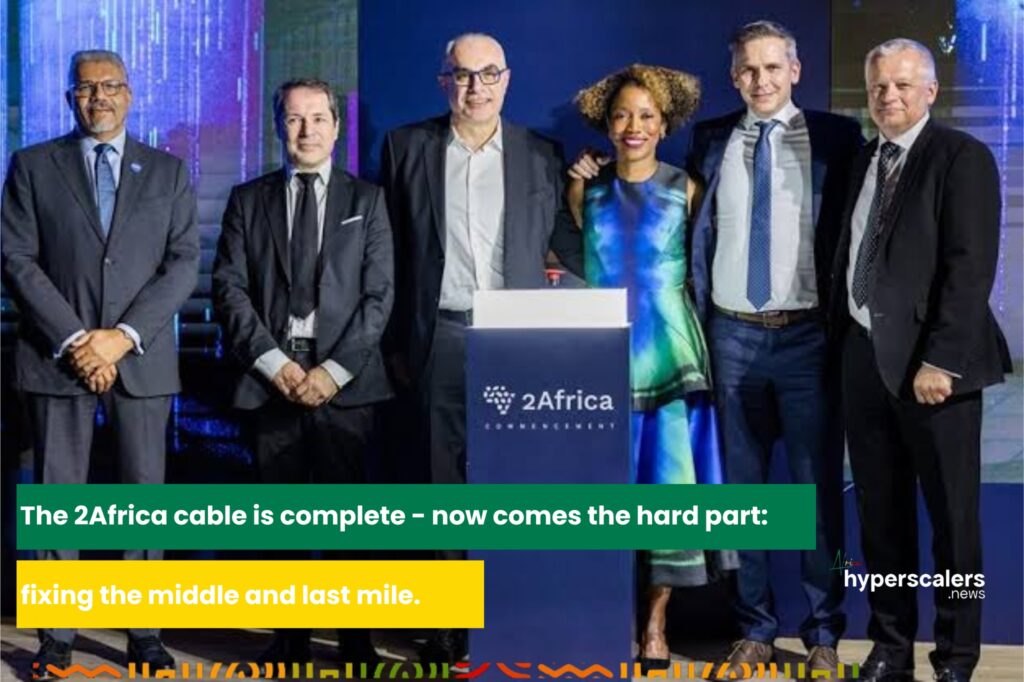
“For MTN, 2Africa isn’t just a cable but rather a statement of intent of what can be achieved when the world’s technology leaders and Africa’s own champions come together with purpose,” said Mazen Mroué, CEO of MTN Group Digital Infrastructure. His words echo an industry consensus: that the greater challenge lies ahead in translating subsea abundance into last-mile impact.
The collaboration required to build 2Africa forced regulators in 33 landing countries to rethink licensing, access, and protection for undersea assets. That evolution has not yet occurred with terrestrial fiber. “2Africa’s core completion is more than engineering – it’s regulatory evolution in action. Spanning 33 African landings, the system has driven new open-access standards and encouraged regulators to modernise how subsea connectivity is licensed and managed. This is what strategic and regulatory alignment looks like at scale,” said Douglas Njenga, WIOCC Group Regulatory and Strategic Affairs Director and an ICPC EC member.
Achieving similar alignment inland is far more complex. Every government sets its rights-of-way fees. Fiber cuts occur daily in key markets. Metro buildouts are often duplicated by competing operators – raising costs while leaving rural areas unserved. National backbones lack redundancy, leaving whole regions vulnerable to single points of failure. Subsea capacity is plentiful; inland capacity is scarce, expensive, and unevenly distributed. Without a coordinated middle-mile and last-mile strategy, the 2Africa cable risks becoming a Formula One engine connected to a dirt road.
Across the continent, investors are turning their attention to a problem long overshadowed by shiny subsea announcements: the lack of commercially viable, carrier-neutral middle-mile networks. Development finance institutions note that for every dollar invested in subsea infrastructure, Africa needs multiple invested inland to unleash equivalent economic impact. But it is not as easy as it often seems. Subsea cables enjoy predictable demand and committed anchor tenants. The middle mile does not. It requires messy coordination among governments, municipalities, tower companies, ISPs, operators, and utilities – a coalition of players who are frequently competitors. The risk profile is messier, and returns slower. Without these arterial networks, Africa’s cloud and AI revolutions will not scale.
Meanwhile, last-mile connectivity remains the most stubborn barrier to inclusion. While mobile has become Africa’s default broadband, it is not suitable or dependable to accelerate digital participation, remote work, e-commerce, or AI-enabled industry. Yet last-mile fiber is prohibitively expensive to deploy. In some cities, operators pay multiple agencies for permits on a single route. Road construction destroys fiber. Vandalism and theft add layers of cost and uncertainty.
Samuel Taylor Coleridge captured this perfectly in his 1798 poem, The Rime of the Ancient Mariner (paraphrased): surrounded by water, yet unable to drink a single drop.
Subsea abundance meets street-level scarcity.
Africa now faces a choice: replicate the collaboration that built 2Africa or allow the benefits of the world’s largest subsea cable to dissipate before reaching its people. Operators, regulators, and investors widely agree that three shifts are needed. First, co-build frameworks – shared ducts, shared trenches, shared metro rings – to reduce duplication. Second, a new regulatory approach that harmonizes rights-of-way, enforces infrastructure protection and applies open-access principles inland. And third, financing models that bring Development Finance Institutions (DFIs), pension funds, and private credit into long-term national fiber programs.
The completion of the 2Africa system marks a turning point not because it ends a journey, but because it begins a harder one. Delivering 180 Tbps of open capacity to coastal cities means little if the rest of the country remains offline, underserved, or dependent on fragile, legacy networks. The subsea collaboration model, once thought impossible, has proven Africa’s ability to build big, bold, shared infrastructure. The question now is whether the continent can replicate that success inland, where the real work – and the real opportunity – awaits.
If 2Africa taught Africa anything, it is this: collaboration at scale is not only achievable, it is essential. The continent’s digital future will be shaped by its collaboration velocity – the speed and ease with which its stakeholders align to tackle problems long considered intractable.
Ready to dive deeper into the hyperscale revolution impacting Africa?
READ MORE HERE: www.africa.hyperscalers.news
Contact Us:
Email: projects@hyperscalers.news
Phone: +2348109003350
Follow us on Social Media: Instagram, Facebook, LinkedIn, x