

Africa’s ambitions to scale data centers and support AI infrastructure will not be realized through traditional grid expansion alone. Instead, operators are increasingly turning to hybrid energy systems, localized generation models, and anchor-demand power strategies to support the continent’s next phase of digital infrastructure growth. The shift reflects a broader structural change as AI workloads redefine the relationship between compute deployment and energy availability.
That was the central message from industry leaders speaking during a panel session at GITEX Africa titled “Power is the platform: can data centers scale without the grid?”
Hady Stephan, Vice President for Secure Power at Schneider Electric Middle East and Africa, said grid dependence alone cannot support Africa data center expansion, as grid-dependent strategies are no longer viable in markets facing persistent reliability constraints.
“The grid cannot be the strategy for Africa. It is more of a liability,” Stephan said, pointing to South Africa’s experience in 2023, when more than 200 days of load shedding forced operators to rely heavily on alternative energy systems.
As a result, many developers are now designing facilities to operate with substantial onsite generation capacity. While hybrid energy architectures increase costs by roughly 10 to 20 percent, Stephan noted they are becoming essential for reliability and bankability. Solar generation, combined with batteries and selective grid use, is expected to dominate future deployments, with photovoltaic infrastructure likely to play a leading role by 2030.
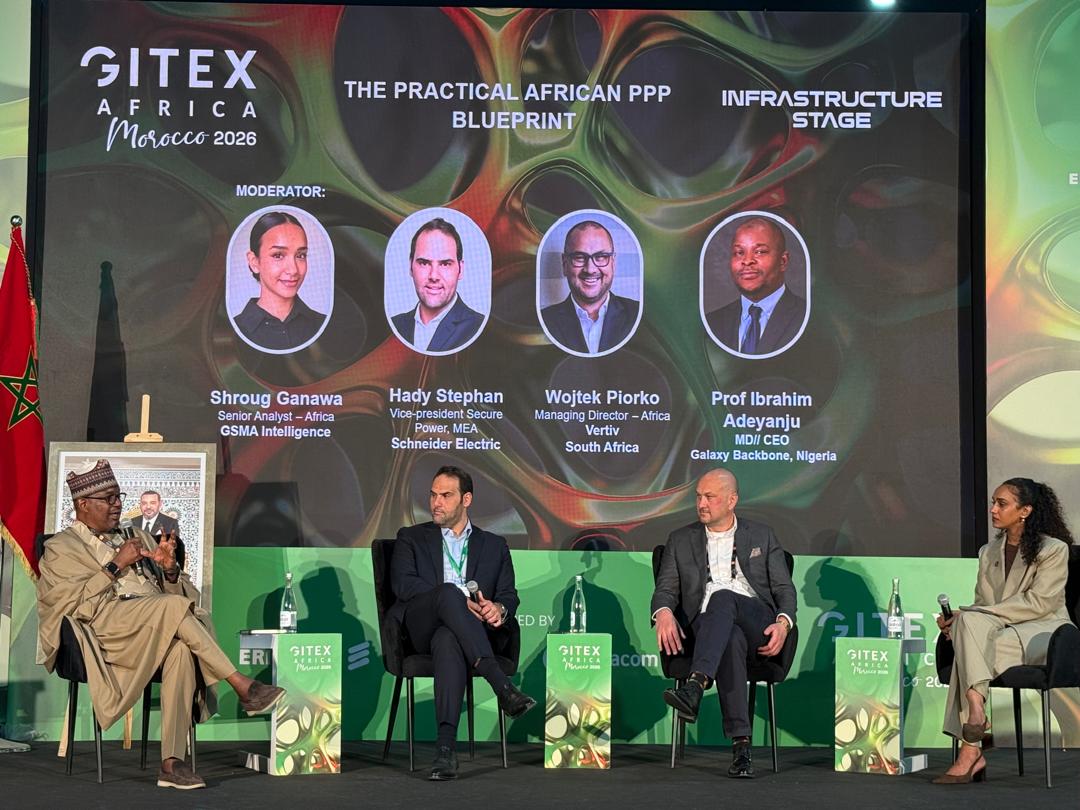
Vertiv Africa Managing Director Wojtek Piorko said Africa is not alone in confronting power constraints as AI workloads reshape infrastructure planning globally. The rapid variability of AI demand is forcing operators everywhere to rethink how energy systems are designed and integrated.
However, Africa’s long experience operating telecom infrastructure in hybrid environments provides a practical foundation for scaling similar approaches for data centers. Across the continent, grid dependence doesn’t support Africa digital infrastructure expansion as tower operators already combine grid supply, solar generation and battery storage to maintain uptime. These models, he said, can now be adapted to support higher-density compute platforms.
Ibrahim Dikko, Chief Executive Officer of Backbone Connectivity Nigeria, argued that power availability is becoming the primary determinant of where digital infrastructure can be deployed worldwide.
He cited SoftBank’s $4.2 billion investment to upgrade grid capacity in Ohio as evidence that even mature markets are restructuring energy systems around data center demand.
Africa, he said, has an opportunity to move faster by colocating compute infrastructure directly with generation capacity. Nigeria’s gas resources, in particular, position the country to generate significant additional power for digital infrastructure if structured around long-term offtake commitments from anchor tenants such as hyperscale operators.
Emphasizing that grid dependence alone cannot support Africa’s data center expansion, Dikko said that rather than waiting for national grids to expand, he proposed reversing the traditional infrastructure sequence by monetizing energy assets first and allowing transmission networks to follow demand created by large-scale compute deployments.
Africa is estimated to have access to between 250 and 300 gigawatts of energy potential, with roughly one-third coming from renewable sources, including hydro, solar and wind. The constraint, panelists said, is not resource availability but how effectively energy systems are structured to support digital infrastructure growth.
As AI-driven compute demand accelerates globally, Africa’s competitive advantage may lie in its ability to bypass legacy grid-first expansion models and instead build flexible hybrid energy platforms designed specifically for next-generation data centers.
Related: Power, energy transition and Africa’s data centers