
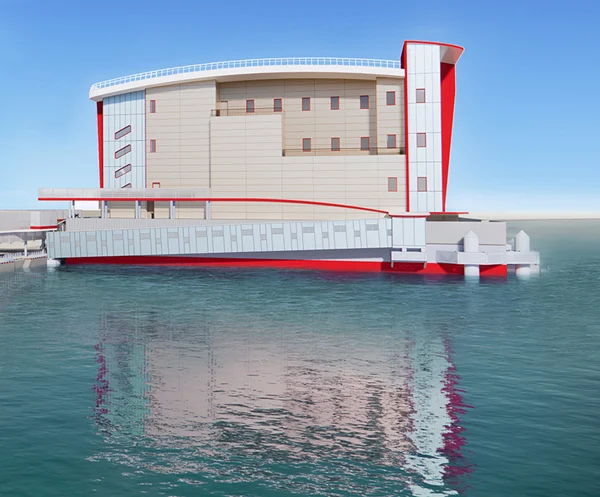
Floating data centers are moving from experimental concepts to deployable infrastructure platforms as Singapore-based Keppel begins construction of a 25MW floating data center designed to support hyperscale workloads, marking one of the clearest signals yet that offshore compute infrastructure is becoming part of the global data center toolkit.
The project, funded through Keppel Data Centre Fund II and already committed to a global hyperscale customer, is expected to go live in 2028. Located at 25 Loyang Crescent in Singapore, the modular development will combine a four-story, 19.2MW waterborne module with supporting shoreside infrastructure, occupying approximately 9,870 square meters of land and 7,580 square meters of adjacent sea space. The facility will use seawater cooling, positioning it as a practical response to land scarcity, power constraints, and thermal management challenges increasingly shaping next-generation data center siting decisions.
Floating data centers are gaining attention globally as operators confront the physical limits of traditional campus expansion in dense metropolitan markets. Singapore in particular has faced sustained land and energy constraints on new data center developments, prompting regulators and operators to explore alternative infrastructure models that preserve capacity growth while maintaining environmental compliance.
Keppel’s deployment builds on a growing body of experimentation with offshore and subsea compute infrastructure. Microsoft previously tested underwater data center modules through its Project Natick initiative, demonstrating the technical viability of sealed subsea compute environments powered by renewable energy and cooled by surrounding ocean conditions. Other initiatives have followed. US-based Nautilus Data Technologies launched a 6.5MW floating barge data center in California, while French startup Denv-R deployed containerized floating compute infrastructure in Nantes. In Japan, a consortium including Mitsui O.S.K. Lines, Kinetics, and Hitachi is advancing offshore floating data center platforms integrated with solar and battery systems. These developments indicate that water-based compute infrastructure is evolving from prototype experimentation toward modular deployment strategies for constrained urban and coastal markets.
Rather than replacing terrestrial facilities, floating platforms are emerging as complementary infrastructure capable of supporting edge expansion, hyperscale spillover capacity, and distributed AI inference environments where land access and grid availability are limited. For rapidly urbanizing regions, including parts of Africa’s coastal digital corridors, these models could become increasingly relevant as demand for localized compute begins to outpace traditional siting options.
The Singapore project also highlights a broader structural shift in how operators are approaching future data center growth. Instead of relying solely on large inland campuses, infrastructure developers are exploring hybrid siting strategies that integrate coastal, modular, and energy-adjacent deployments into national compute architectures.
For Africa, where major coastal gateway cities such as Lagos, Mombasa, Accra, and Cape Town already anchor subsea cable landings and interconnection ecosystems, floating and subsea data center models could eventually complement terrestrial infrastructure as compute demand scales alongside cloud adoption and artificial intelligence deployment.
The Keppel announcement follows a wider global trend toward infrastructure diversification as operators respond to land availability constraints, grid bottlenecks, and rising cooling requirements associated with AI-intensive workloads. Increasingly, the question is no longer whether water-based compute infrastructure is feasible, but where it becomes economically justified as part of next-generation digital infrastructure planning.