

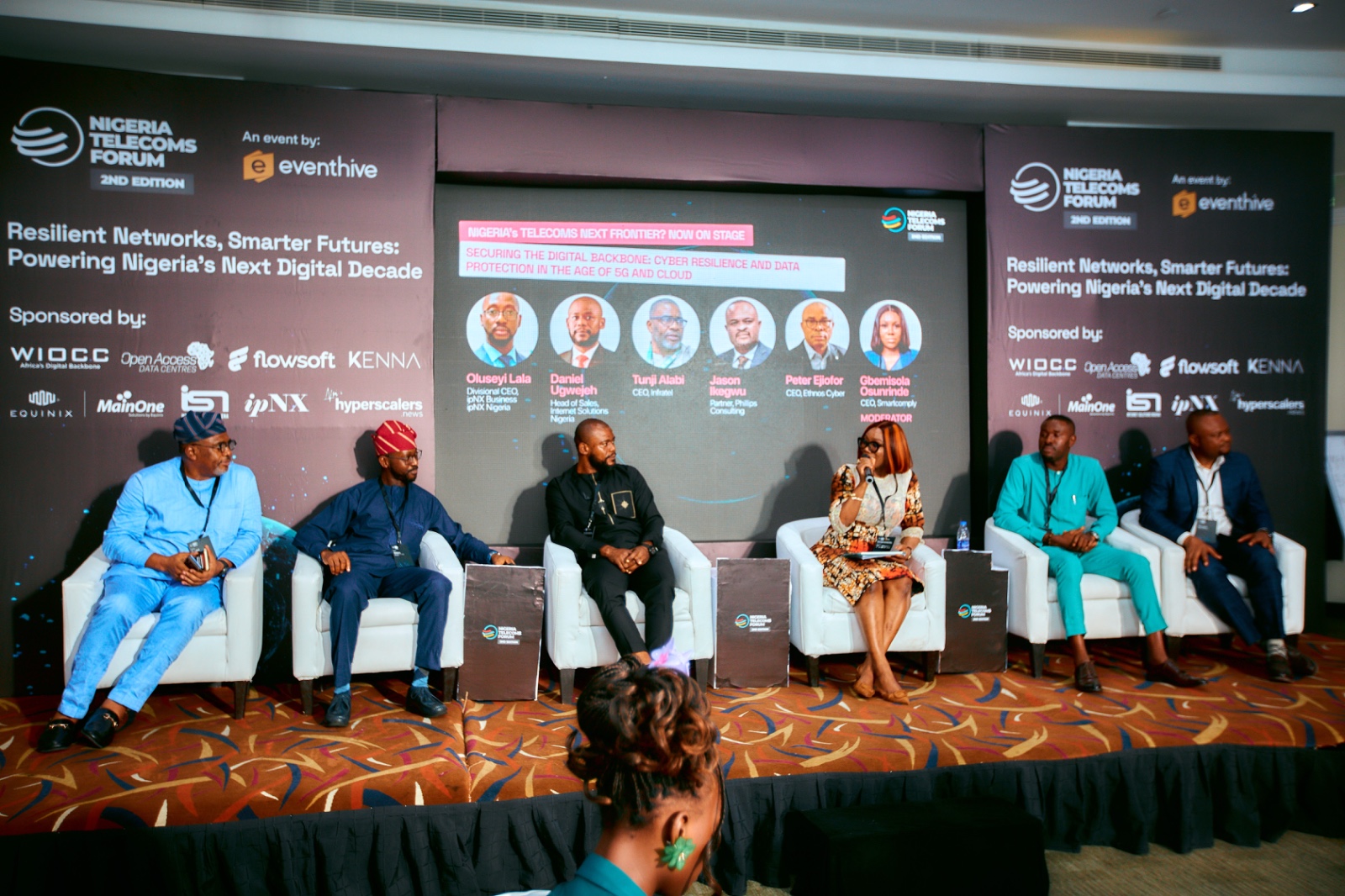
Industry leaders across Nigeria’s telecommunications, infrastructure, and cybersecurity ecosystem have called for a fundamental shift in how operators and enterprises approach security, warning that compliance-driven models are no longer sufficient to protect the country’s expanding digital backbone. Speaking at a dedicated cyber resilience session during the Nigeria Telecoms Forum, panelists argued that Nigeria must transition from reactive regulatory alignment toward “cyber resilience by design” – embedding security into infrastructure architecture, governance frameworks, and operational culture from the outset.
The session, moderated by Gbemisola Osunrinde, Chief Executive Officer, smartcomply, brought together senior representatives from Infratel, ipNX, ISN, Phillips Consulting, and Ethnos Cyber to examine emerging risks across Nigeria’s connectivity infrastructure stack, from fiber and towers to enterprise networks and cloud environments.
Participants emphasized that the threat landscape is evolving faster than institutional responses, creating structural exposure across sectors that increasingly depend on digital platforms for service delivery.
Peter Ejiofor, Chief Executive Officer, Ethnos Cyber, represented by Innocent Mbulu highlighted what he described as a persistent vulnerability gap across organizations responding to Nigeria’s data protection requirements. According to him, many institutions still approach compliance as an episodic exercise triggered by audits rather than a continuous operational discipline.
“The most exploitable vulnerability in the entire chain – from the cloud to the end-user – is the human being,” Mbulu said, stressing that policies and tools cannot compensate for weak organizational awareness or insufficient training at the user level.

He noted that building resilient digital infrastructure requires sustained investment in workforce capability, not just regulatory documentation.
Tunji Alabi, Chief Executive Officer, Infratel, warned that cybersecurity discussions in Nigeria often overlook physical network layers, even though fiber corridors, towers, and terrestrial transmission assets form the foundation of national connectivity systems.
“We focus on data centers but forget the fiber cables and towers,” Alabi said, pointing to the need for a broader infrastructure protection strategy that integrates both cyber and physical security planning.
Osunrinde reinforced this point by highlighting the importance of operational preparedness through simulation exercises rather than policy frameworks alone. “If we have processes but have not simulated a response to a coordinated attack, we cannot truly respond when it eventually happens,” she said.
Jason Ikegwu, Partner, Phillips Consulting identified what panelists described as a boardroom gap in cybersecurity oversight, noting that many organizations still treat cyber risk primarily as a technical issue rather than an enterprise governance priority.
This approach, he warned, is increasingly unsustainable as artificial intelligence expands the scale and sophistication of threat activity. Referencing recent discussions around advanced AI-assisted intrusion capabilities, including Anthropic’s “Mythos” model, Ikegwu argued that executive leadership must begin treating cybersecurity as a strategic business continuity issue.
Closing the session, Osunrinde outlined Smartcomply’s approach to supporting institutional cyber readiness through an integrated resilience ecosystem designed to align compliance, skills development, and proactive threat intelligence.
The framework includes automated governance, risk, and compliance visibility through its Seequre and Smartguard platforms; workforce training through Smartcomply Academy; and proactive monitoring tools such as Oculus for dark web intelligence and Adhere for fraud prevention aligned with Central Bank of Nigeria guidance.
Across the discussion, panelists agreed that Nigeria’s digital infrastructure is entering a new phase in which cybersecurity can no longer be treated as a regulatory obligation alone. Instead, it must be embedded directly into the architecture of telecom networks, enterprise systems, and national connectivity platforms.
As Nigeria’s digital backbone continues to support financial inclusion, cloud adoption, AI deployment, and public-sector digitization, participants concluded that resilience by design will determine whether infrastructure expansion translates into long-term economic trust and stability.
Further reading:
- African Union / international cyber resilience by design approaches → https://au.int/en/pressreleases/20260217/auc-google-sign-partnership-advance-africas-sovereign-ai-digital-capacity
- Nigeria’s cybersecurity landscape and regulatory frameworks → https://ncc.gov.ng/sites/default/files/2026-03/Cyber-Resilience-Framework-for-Nigeria-Communication-Sector-%28CRF-NCS%29.pdf
Related: Cybersecurity, governance and digital infrastructure in Nigeria