

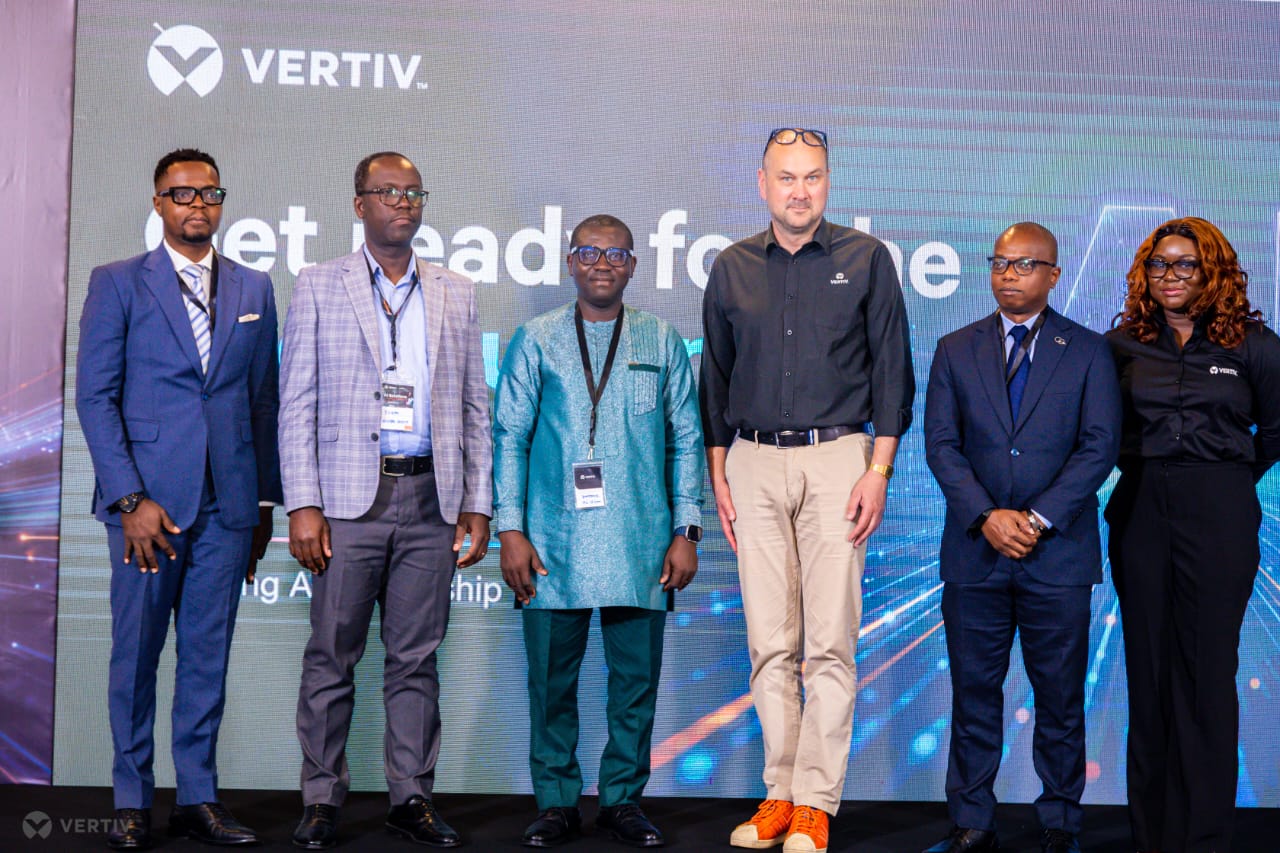
Ghana’s ambition to build a competitive artificial intelligence ecosystem will depend less on policy announcements and more on enforcement, infrastructure readiness, and coordinated investment across the digital stack, according to stakeholders at a recent industry dialogue in Accra.
At the AI Infrastructure Readiness session hosted by Vertiv in partnership with Africa Hyperscalers, industry leaders and policymakers converged around a central theme: AI adoption in Ghana is no longer constrained by awareness, but by execution.
A key point of consensus was the role of regulation in shaping demand for local infrastructure.
Oluwaseun Layade, Head of Project Management and Corporate Development at CWG Ghana, argued that stronger enforcement of data sovereignty and localization policies will be critical to driving meaningful AI adoption.
“Without enforcement, we are just talking,” he said, noting that stricter compliance would compel organizations to retain computing workloads domestically, creating sustained demand for local data center capacity and related digital services.
This reflects a broader shift across African markets, where regulators are moving from policy development to implementation. As governments push for greater control over data and digital systems, infrastructure markets are being forced to respond.
However, participants noted that regulatory momentum is not yet matched by infrastructure scale.
Power availability remains a binding constraint. AI workloads, particularly those involving high-performance computing, require stable and continuous electricity supply – a factor that continues to shape investor decisions across emerging markets.
At the same time, Ghana’s digital infrastructure base – including expanding terrestrial fiber networks and growing data center presence – remains in the early stages relative to projected AI-era demand.
A speech delivered on behalf of the Minister for Communication, Digital Technology and Innovations reinforced government intent to position Ghana as an active participant in the global AI economy, rather than a passive consumer of external technologies. Represented by Emmanuel Ofori, Director of the Innovations Directorate, the Minister emphasized that the recently launched national AI strategy will be implemented with measurable outcomes, alongside a cautious approach that balances innovation with responsible and ethical deployment.
Beyond policy direction, the session highlighted a structural reality: no single actor can deliver AI readiness alone.
Temitope Osunrinde, Director at Africa Hyperscalers, stressed that Ghana’s AI future will depend on coordinated partnerships across government, telecom operators, cloud providers, academia, and investors.
“Ghana’s AI ambitions will depend heavily on trusted partnerships capable of accelerating digital infrastructure deployment, expanding access to computing power and connectivity, and supporting practical AI applications across sectors,” he said.
The discussion also underscored a broader market transition. Ghana, like many African economies, is moving from a decade of connectivity-led growth toward a compute-driven phase, where the location of data processing and the availability of local infrastructure will increasingly determine where economic value is captured.
For Ghana, the next phase of digital transformation will not be defined by access to AI tools, but by the ability to host, power, and govern them locally.
Whether the country can align regulatory enforcement, infrastructure investment, and enterprise demand will determine if it emerges as a regional hub for AI and cloud services – or continues to rely on external platforms for critical digital capacity.
Further reading:
- Vertiv AI‑ready data centers and critical infrastructure → https://vertiv.com
- Ghana’s national AI strategy and AI readiness → https://www.mint.gov.gh/president-mahama-launches-ghanas-national-ai-strategy-calls-for-ai-that-reflects-ghanaian-values/