
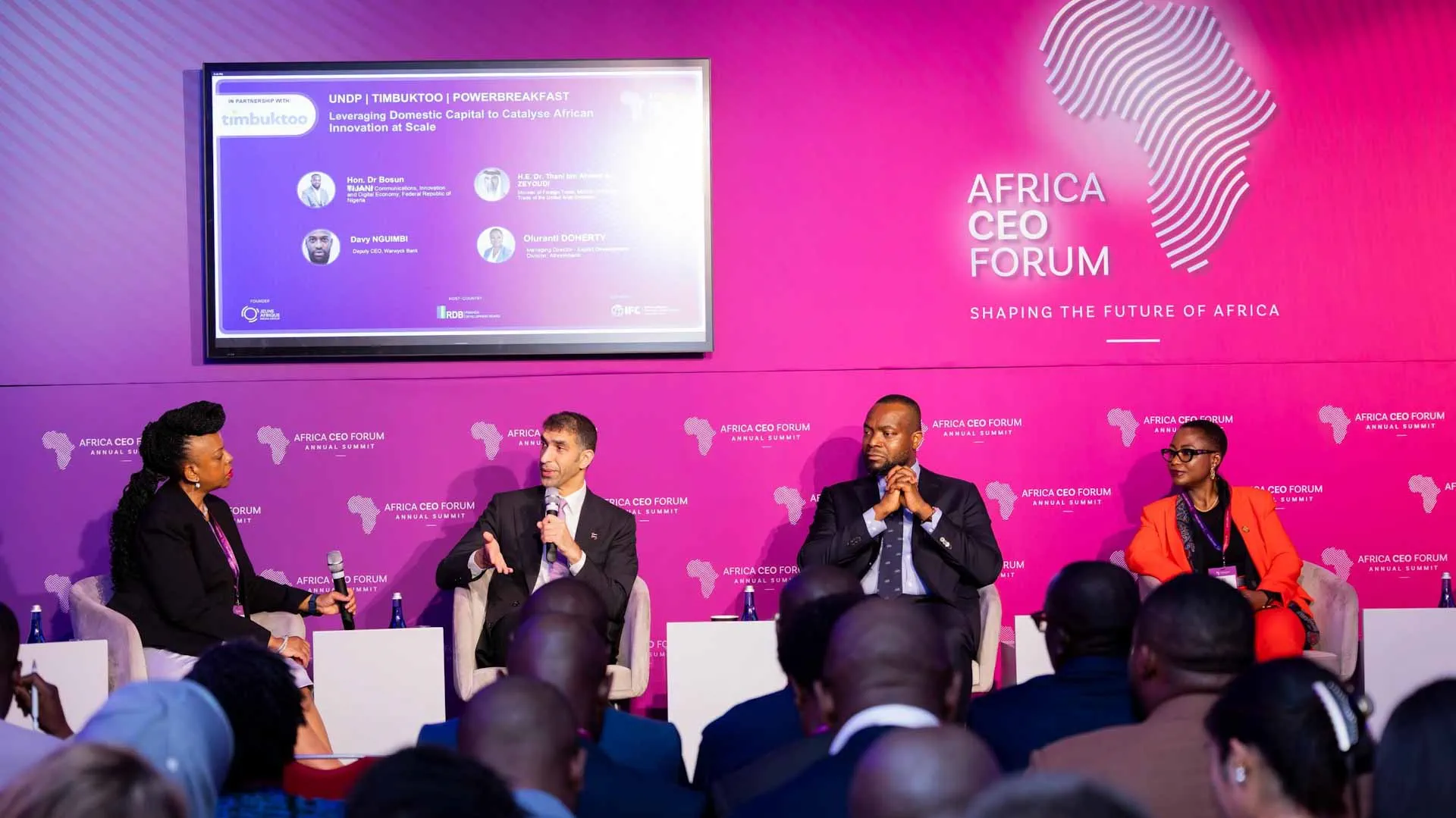
The 2026 edition of the Africa CEO Forum in Kigali made one thing increasingly clear: Africa’s next growth phase will depend less on announcing opportunity and more on building the systems capable of absorbing long-term capital at scale.
Held under the theme “The Scale Imperative: Why Africa Must Embrace Shared Ownership,” the forum reflected a growing recognition that fragmented national approaches are becoming insufficient for the scale of infrastructure, industrialization, and digital transformation the continent now requires.
This year’s gathering drew more than 2,500 CEOs, investors, development finance institutions, policymakers, and government officials, alongside one of the strongest levels of presidential participation in recent years. Leaders present included President Paul Kagame of Rwanda, President Bola Ahmed Tinubu of Nigeria, President Mohamed Ould Ghazouani of Mauritania, President Daniel Chapo of Mozambique, President Mamadi Doumbouya of Guinea, and President Brice Clotaire Oligui Nguema of Gabon. Executives, investors, and policymakers from more than 75 countries attended the event, reinforcing the increasingly continental nature of Africa’s investment and infrastructure agenda.
Unlike previous editions, where discussions often centered on Africa’s long-term promise, this year’s conversations were noticeably more grounded in implementation: project preparation, capital mobilization, institutional coordination, infrastructure bankability, and execution capacity. Across boardrooms, ministerial sessions, and investor roundtables, a recurring concern emerged – Africa’s challenge is increasingly not the absence of opportunity, but whether its markets and institutions are structured deeply enough to convert that opportunity into scalable economic assets.
Regional capital markets return to the forefront
One of the more consequential ideas discussed during the forum was the push toward deeper regional capital market integration, including conversations around regional stock exchange structures capable of improving liquidity, mobilizing larger pools of capital, and strengthening infrastructure financing across African economies.
Supported strongly through IFC-led financial sector discussions, the conversations reflected growing concern that fragmented national exchanges remain too shallow to finance the scale of infrastructure transition Africa now faces. Participants argued that larger, interconnected capital markets would improve funding access for energy, telecoms, transport, logistics, manufacturing, and digital infrastructure projects while also attracting greater institutional participation from pension funds, insurers, and sovereign investors.
The broader message from investors was difficult to ignore: Africa cannot build globally competitive infrastructure markets on fragmented financial systems. Pension reform, long-term domestic capital formation, acquisition financing, and regional investment coordination are increasingly becoming infrastructure priorities in themselves.
Digital infrastructure emerges as a strategic asset class
Digital infrastructure was one of the forum’s strongest and most strategic themes, reflecting the continent’s growing focus on connectivity, AI infrastructure, cloud expansion, sovereign compute, and long-term ownership of critical digital systems.
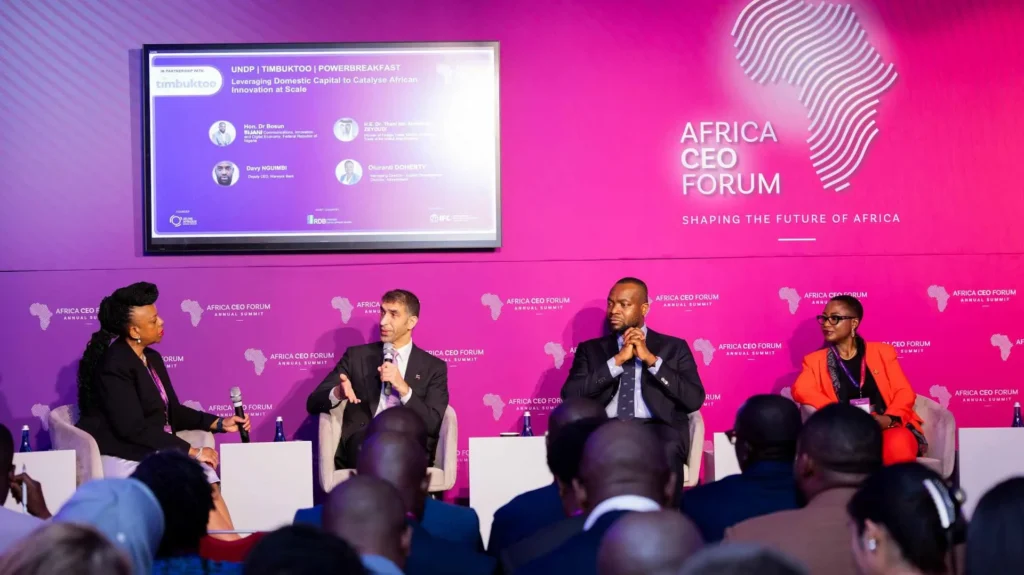
A high-profile session titled “Rise of the BOTs: Building Africa’s Infrastructure in the Age of Tech Sovereignty” explored the future financing and control structures behind Africa’s digital infrastructure buildout, including fiber networks, data centers, sovereign cloud platforms, and AI-ready infrastructure ecosystems.
During the session, Cassava Technologies President and Group CEO Hardy Pemhiwa argued that beyond how Africa builds digital infrastructure, the more strategic question may be who ultimately owns and controls it. Discussions explored whether BOT and BOOT infrastructure models could help African countries attract long-term private capital while still preserving strategic influence over nationally significant digital infrastructure assets.
Several participants also noted a broader transition underway within development finance institutions. DFIs that historically concentrated on transport and traditional public infrastructure are increasingly shifting toward digital infrastructure assets such as fiber networks, data centers, cloud ecosystems, AI compute infrastructure, and the energy systems required to support them. That shift reflects a growing recognition that compute, connectivity, and digital systems are now foundational economic infrastructure rather than peripheral technology investments.
Investors pointed to Africa’s rapid subsea cable expansion as one of the continent’s clearest digital infrastructure success stories. But there was also broad acknowledgement that connectivity alone is no longer enough. Without terrestrial fiber expansion, local interconnection ecosystems, cloud infrastructure, and localized compute capacity, much of Africa’s digital value creation will continue to occur outside the continent.
Côte d’Ivoire pushes an industrial growth narrative
Côte d’Ivoire used the forum aggressively to position itself as one of Africa’s emerging industrial and investment hubs. During the “Invest in Côte d’Ivoire” session, government officials presented the country’s 2026–2030 National Development Plan, outlining ambitions to accelerate growth while mobilizing significantly larger volumes of private capital.
Officials disclosed that the plan would require more than 114 trillion FCFA in investment, with over 70% expected from the private sector. The country also outlined ambitions to strengthen its positioning across manufacturing, logistics, energy, infrastructure, and digital services while increasingly presenting itself not simply as a national economy, but as a regional commercial platform for Francophone West Africa.
… as Angola intensifies investor engagement
Angola also used the forum as a strategic platform to deepen investor engagement and reposition itself within Africa’s next investment cycle. Presidential-level sessions focused on attracting partnerships across infrastructure, energy, industrial development, and financial services.
Government representatives emphasized ongoing reforms designed to improve investor confidence, expand private-sector participation, and diversify the economy beyond hydrocarbons. The strong presence of Angolan institutions throughout the forum reflected broader efforts by the country to reconnect with global capital markets and reposition itself as a more investable destination.
From ambition to execution
Perhaps the clearest takeaway from Africa CEO Forum 2026 was the shift in tone.
The conversations in Kigali were less centered on abstract optimism and increasingly focused on execution discipline, financing structures, institutional depth, policy continuity, and infrastructure readiness. Whether the discussion involved AI infrastructure, sovereign cloud, regional capital markets, energy systems, or industrialization, the recurring question throughout the forum was no longer whether Africa has opportunity.
It was whether Africa can build the institutions, infrastructure systems, and capital structures capable of converting opportunity into bankable, scalable, and long-term economic assets.