

As a massive capital cycle shapes global computing power, Africa stands at a critical crossroads. In this exclusive interview, Obinna Isiadinso, Global Sector Lead for Data Centers and Cloud Investments at the International Finance Corporation, breaks down the realities of the “Africa premium,” the transition to AI inference, and how the continent can unlock its $1 trillion institutional capital pool.
The world is currently witnessing an unprecedented global capital migration. Driven by the exponential rise of artificial intelligence and machine learning, digital infrastructure is undergoing a transformation reminiscent of the major industrial revolutions or the early internet boom. Globally, investments are moving toward an estimated $1 trillion per year over the next five to ten years. U.S. hyperscalers alone project around $600 billion in AI-related capital expenditure (CAPEX) for 2026, leading a massive capacity expansion that aims to add tens of gigawatts across America, Asia, and Europe.
Yet, as the rest of the world races to build gigawatt-scale clusters, a striking disparity remains. Africa represents roughly 15% of the global population but accounts for less than 1% of global data center capacity. The entire continent’s operational capacity sits just shy of 500 megawatts (MW), a footprint roughly on par with a single U.S. tier-two city like Dallas or Chicago. While global players scale rapidly, African markets are tasked with building foundational infrastructure from the ground up amid complex macroeconomic environments.
Bridging this divide requires deep sector expertise and substantial risk capital. As the private sector arm of the World Bank Group, the International Finance Corporation (IFC) has positioned itself at the center of this challenge. Managing a $3 billion global digital infrastructure portfolio, with an intentional 60% of that capital deployed directly across Africa, the IFC is working to de-risk the sector, establish project bankability, and catalyze local and international investments.
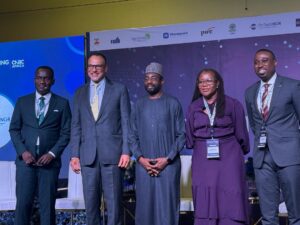
At a Africa Hyperscalers Global View interview session focused on digital infrastructure in Africa, Temitope Osunrinde, Director at Africa Hyperscalers, sat down with Obinna Isiadinso, the IFC’s Global Sector Lead for Data Centers and Cloud Investments. Their conversation offers a masterclass in infrastructure economics, mapping out the evolution of African data markets, the technical shift toward AI inference at the edge, and the structural reforms needed to mobilize Africa’s own $1 trillion institutional asset pool.
Temitope: Looking at the macro picture, we see geopolitical tensions accelerating across key hubs, particularly in the Middle East where U.S. hyperscalers have heavily invested. How are these regional conflicts impacting global data center strategies and resilience?
Obinna Isiadinso: To date, we have recorded minimal overall impact on operational continuity, and that is fundamentally due to how hyperscale infrastructure is engineered. The modern cloud does not rely on single points of failure; it leverages deeply distributed networks and structural redundancy. If a specific data center or an entire availability zone experiences an outage or regional disruption, workloads are seamlessly shifted across global networks to ensure 24/7 data access.
What this geopolitical friction does reinforce, however, is the absolute necessity of regional diversification. It highlights why sovereign digital infrastructure matters. Relying on centralized nodes outside an economic zone introduces vulnerability, which is driving governments and enterprises globally to prioritize localized cloud regions.
Temitope: Let’s talk about Africa’s current positioning. We often hear that the continent has just under 500 MW of total capacity. How does the IFC evaluate the maturity of African markets along the global infrastructure continuum?
Isiadinso: Every digital infrastructure market evolves along a distinct spectrum: Retail Enterprise Co-location to Wholesale Data Centers to Hyperscale Build-to-Suit to AI Data Centers
In highly developed markets like the United States, demand is heavily inverted, roughly 60% to 70% of the market is dominated by hyperscale and wholesale demand.
Africa’s 500 MW landscape is currently the exact opposite. It is split at 60% to 70% retail enterprise co-location, catering to local banks, SMEs, government agencies, and telcos and only 30% to 40% hyperscale presence. Most African markets are still firmly in this foundational retail phase. However, as cloud adoption accelerates, we project this mix will shift closer to a balanced 50/50 split over the next five to ten years.

Temitope: What specific countries are leading this transition? How does the IFC rank these markets?
Isiadinso: The IFC conducted a comprehensive 140-market global study assessing macroeconomic growth, cloud demand, baseline infrastructure; meaning power, water, and fiber connectivity, and regulatory environments. Within Africa, the data clearly establishes a multi-tiered ecosystem:
Primary Hubs: South Africa remains the undisputed leader, accounting for 50% to 60% of the continent’s total capacity at roughly 250 to 260 MW. Nigeria follows as the primary West African engine at 20 to 30 MW, alongside Kenya as the East African anchor at 10 to 20 MW.
Secondary/Transition Markets: Egypt, Morocco, and Ghana are showing strong momentum, positioning themselves as the next frontier for regional expansion.
Temitope: Given that background, where does Africa fit into the global AI narrative? Are we going to see massive AI data centers on the continent anytime soon?
Isiadinso: We need to differentiate between the two distinct architectures of artificial intelligence: AI Training and AI Inference.
AI Training requires massive, gigawatt-scale campuses, thousands of specialized liquid-cooled GPUs, and enormous power densities. These are typically built outside urban centers where power is cheap and abundant. Africa does not yet host AI training data centers. While South Africa’s Teraco has an impressive 100 MW facility, it is currently optimized for traditional cloud and enterprise demand.
Africa’s immediate future lies firmly in AI Inference. Models are trained globally in massive facilities over 12 to 18 months, but the trained models are then deployed locally at the edge. AI inference data centers are typically smaller – 10 to 50 MW – and must be built directly within African urban centers to keep latency ultra-low for local consumers interacting with applications like agentic AI in fintech or logistics.
The definitive upcoming trend for Africa will be the rise of 20 MW hybrid data centers, where 10 MW is dedicated to standard enterprise co-location and 10 MW is geared entirely toward high-density AI inference.
Temitope: Let’s discuss the economics of building these facilities. What are the actual capital expenditure realities on the ground?
Isiadinso: Building data centers is capital-intensive, and the numbers are climbing. As a global baseline, constructing standard data center infrastructure costs roughly $10 million to $12 million per megawatt. The internal IT equipment, that is; the servers, racks, and chips, generally doubles that asset value, adding another $10 million to $12 million per MW.
In Africa, developers face what we call the “Africa Premium.” Infrastructure development costs regularly rise to $10 million to $15 million per megawatt. This premium is driven by structural bottlenecks: the necessity of importing specialized technical labor, high shipping and logistical costs for heavy equipment, and localized import duties and taxes.
Furthermore, as we move toward AI inference, the pressure on power density increases costs even more. Standard enterprise racks pull 5 to 10 kW. AI racks pull anywhere from 30 kW to 200 kW. Engineering a facility to support that level of power and cooling pushes African AI-ready infrastructure costs up to $15 million to $20 million per megawatt.

Temitope: Given these high costs, securing financing is a major hurdle. How does the IFC view project bankability, and how do funding structures differ between retail and hyperscale builds?
Isiadinso: This is a critical distinction that developers must understand. Data center construction timelines average 18 to 24 months, but the financing mechanics during and after construction look completely different depending on the asset class.
Retail Co-location Data Centers: These are high-risk for lenders because local tenants refuse to sign contracts until the building is completely finished and tested. As a result, developers must fund construction almost entirely out of their own pocket using Sponsor Equity. Once built, these facilities face a slow stabilization window, taking an additional 2 to 3 years just to ramp up occupancy to a cash-flowing 60%. Because of this risk profile, lenders like the IFC typically step in much later, introducing debt only to refinance the equity once customer contracts actually start converting.
Wholesale / Hyperscale Data Centers: These projects are highly contract-driven and funded from the start through a parallel mix of equity and Lender Debt. They rely heavily on securing “pre-lets” from major anchor tenants before breaking ground, which guarantees immediate occupancy and lease utilization the moment the facility is delivered. Because of these guaranteed contracts, lenders are willing to commit debt early in the process, though they structure the agreement so that the funds only disburse once a signed contract with a credible hyperscaler is officially executed.
Temitope: Finally, let’s address local capital. Africa has close to $1 trillion sitting in domestic pension funds and sovereign wealth funds, yet very little goes into digital infrastructure. How do we unlock this capital?
Isiadinso: It is worth noting that this is a global challenge, not just an African one. Institutional investors worldwide typically allocate only about a 5% portfolio exposure to digital infrastructure, remaining heavily weighted in traditional commercial real estate, bonds, and equities.
However, two major shifts are required to unlock African institutional capital:
First, there must be a mindset shift toward viewing digital infrastructure as a utility. Post-COVID, it is clear that fiber networks, towers, and data centers are no longer speculative technology plays; they are mission-critical public utilities with highly predictable, long-term inflation-linked cash flows, perfectly matching the long-term liabilities of pension funds.
Second, we must bridge the “In-House Capacity” gap. Western pension funds invest billions in this asset class because they possess highly specialized, in-house private equity and private credit teams who intimately understand data center engineering, lease structures, and technology risks.
African pension and sovereign funds currently lack that specialized internal capacity. For them to confidently deploy capital into greenfield digital infrastructure, they must intentionally build these technical investment teams or actively co-invest alongside experienced Development Finance Institutions like the IFC. By partnering with us, local institutional capital can safely de-risk its entry into the asset class that will power Africa’s future economy.
Temitope: If there were a single “silver bullet”, one definitive action or decision that policymakers and investors should double down on to significantly accelerate digital infrastructure deployment across the continent over the next decade, what would it be?
Isiadinso: While this is a highly dynamic and rapidly evolving space, if there is one definitive lever, it is strategic collaboration across the entire value chain.
Digital infrastructure is deeply ecosystem-dependent; no single entity can drive it in isolation. The private sector cannot do it alone, and neither can the public sector. Moving African markets forward over the next 5 to 15 years requires a sustained, collaborative framework that actively bridges gaps between multiple stakeholders:
Public-Private Alignment: Maintaining a constant dialogue to co-develop infrastructure roadmaps, policies, and regulatory plans.
Capital Harmonization: Creating frameworks that blend the strengths of global tech players and foreign direct investment with local capital and domestic institutional investors.
Capacity Building: Collaborating to systematically develop local technical talent alongside physical assets.
Ultimately, the closest thing we have to a silver bullet is leveraging the unique capabilities of every actor, foreign and local, public and private, and bringing them together to scale the ecosystem collectively.