
Africa’s growing digital economy is creating demand for data centres and AI infrastructure, but demand alone will not bring global capital. As investment accelerates worldwide, African cities must compete on construction costs, power, incentives and speed to market.
Africa has spent much of the past decade making the case for greater investment in its digital infrastructure. The next challenge may be considerably harder: competing for that investment.
As artificial intelligence drives a global expansion of data centres, the capital required to build the next generation of digital infrastructure is becoming increasingly contested. African markets are therefore not simply competing with one another for data centre and cloud investment. Lagos, Nairobi, Johannesburg, Cape Town, Cairo and Casablanca are competing with established and emerging data centre markets from India to Malaysia and Vietnam.
The big question is how African markets can offer investors economics attractive enough to deploy capital there.
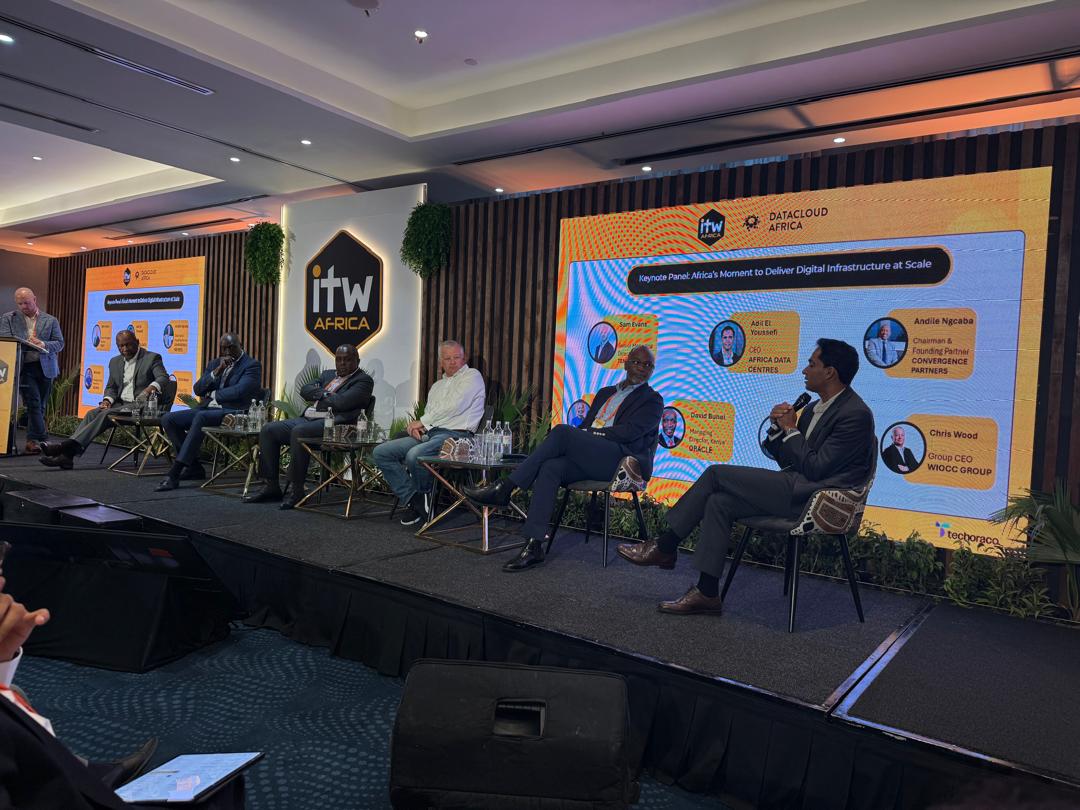
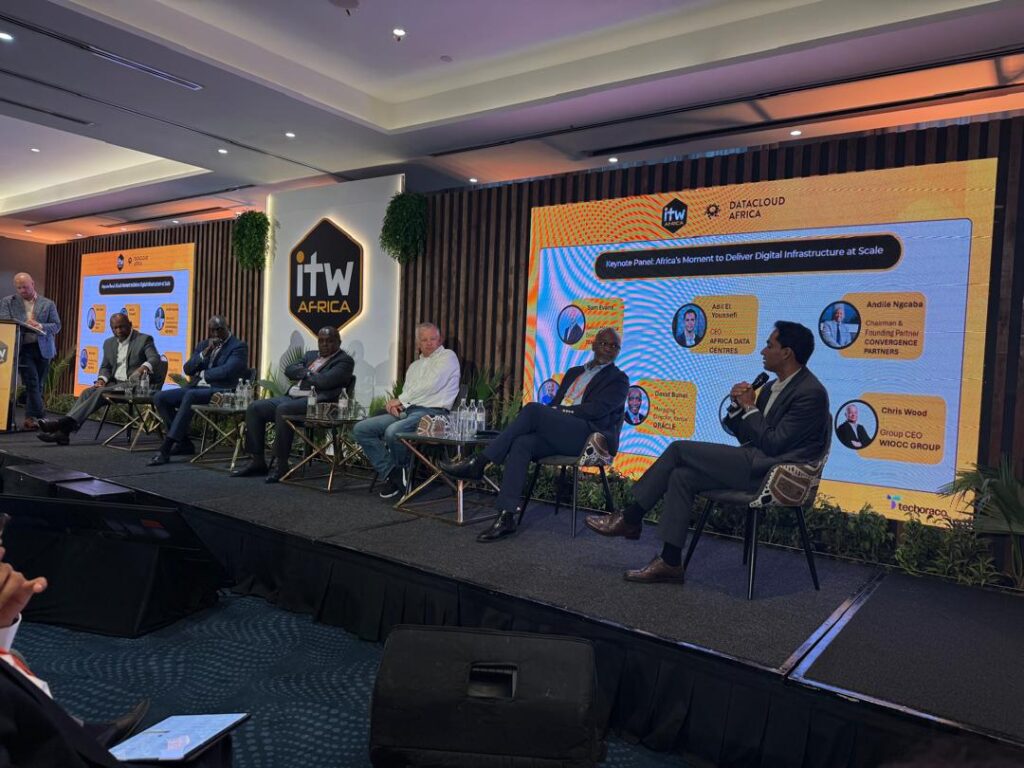
During the keynote panel “Africa’s Moment to Deliver Digital Infrastructure at Scale” at ITW Africa, featuring Chris Wood, Wole Abu, Adil El Youssefi, Mugo Kibati and David Bunei, Andile Ngcaba, Chairman of Convergence Partners, argued that African governments need to recognise that investment decisions are being made within a global market. “As Africa, we’re competing with other parts of the world” to attract investment, he said, pointing to incentives offered by countries such as India, Malaysia and Vietnam to attract data centre investment, ranging from permitting to the taxation of imported GPUs.
The cost of a megawatt matters
The economics become particularly stark when measured by the cost of building data-centre capacity.
During the discussion, Ngcaba, contrasted construction costs across global markets, arguing that African cities need to reduce the cost of bringing new capacity online if they are to compete more effectively for international investment.
Independent industry data supports the wider point, although some of the figures cited during the session appear to reflect earlier benchmarks.
Turner & Townsend’s latest Data Centre Construction Cost Index puts Tokyo at $15.2 per watt — equivalent to approximately $15.2m per megawatt — making it the world’s most expensive market in the index. Singapore follows at $14.5/W and Zurich at $14.2/W. Lagos, meanwhile, is estimated at $10.5/W, or about $10.5m/MW.
The Lagos figure is particularly revealing. The city entered Turner & Townsend’s previous index as the seventh-most expensive market, reflecting the high cost of establishing supply chains and expertise in a relatively young data-centre market. As those capabilities have become more established, Lagos has fallen to 27th in the latest ranking.
That suggests infrastructure competitiveness is not static. Costs can decline as markets mature, supply chains deepen and specialist skills become locally available.
The precise cost of any facility will vary by specification, scale and location. Turner & Townsend’s benchmark represents a typical 30 – 50MW air-cooled hyperscale data centre and excludes costs including land, utility works and active IT equipment. AI-ready, liquid-cooled facilities can also be more expensive: its US project data indicates a 7 – 10% construction premium over comparable air-cooled facilities.
But the broader argument made in Nairobi remains significant: African cities are competing in a global market for data centre capital, and the cost of delivering each megawatt of capacity influences where that capital ultimately goes.
Cost is about more than construction
Every additional cost imposed on an African data centre project affects its competitiveness against an alternative location elsewhere. That includes construction, imported equipment, financing and taxation. It also includes two factors that are particularly important for data centres: electricity and time.
Regulatory and permitting delays that extend a project’s development schedule have an economic cost. So does unreliable or expensive power. The discussions therefore placed permitting, investment incentives and electricity alongside construction costs in determining whether a market is attractive for data centre development.
Power may prove particularly important as AI infrastructure expands.
Turner & Townsend identifies power availability and long grid-connection lead times as critical constraints on data-centre development globally. AI facilities intensify the challenge because higher-density computing requires substantially greater power and more sophisticated cooling infrastructure.
For African markets, this creates both a constraint and an opportunity.
Countries capable of combining abundant energy resources with competitive data centre development environments could position themselves for a larger share of global compute investment. But inexpensive energy alone will not be enough if grid connections, permits, imported equipment or construction delays undermine the economics.
Demand is necessary, but not sufficient
The continent has many advantages.
Africa’s population is young, internet adoption continues to expand, financial services are increasingly digital, governments are digitising public services and enterprises are moving workloads into the cloud. Artificial intelligence adds another potentially significant source of computing demand.
At ITW Africa, The governments of Nigeria and Kenya made that argument to investors.
In separate events, officials described digital infrastructure as central to their respective country’s economic development strategy, and highlighted the existing data centre base and recent capacity additions. But underlying demand and bankable demand are not necessarily the same thing.
Data centre developers require customers capable of signing sufficiently large and long-term contracts to support substantial upfront investment. Hyperscale facilities in particular are built around confidence that computing capacity will be consumed.
The discussion in Nairobi highlighted governments and financial institutions as potentially important anchor customers. Policies that encourage government workloads and financial-sector data to be hosted domestically can create predictable demand and strengthen the investment case for additional local capacity.
Nigeria’s National Sovereign Cloud Initiative and the Central Bank’s data-sovereignty policies signal an intention to stimulate this domestic demand. This suggests that Africa’s emerging data-sovereignty policies could have an impact beyond regulation: if designed and implemented effectively, they can help convert existing digital activity into demand for local infrastructure.
But localisation requirements alone will not solve the competitiveness challenge. Requiring data to remain within a country without making local infrastructure cost-competitive, reliable and scalable risks increasing costs for the businesses required to use it.
The stronger proposition is therefore not simply to mandate local hosting, but to make it commercially attractive as well as strategically desirable.
Africa is competing against Asia -and itself
This is where the global comparison matters.
Countries across Asia have spent years building ecosystems designed to attract electronics manufacturing, cloud infrastructure and data centres. Investors evaluate tax regimes, equipment-import rules, permitting timelines, energy availability, connectivity, skills and political stability before deciding where to allocate capital.
Africa’s governments increasingly need to think in similar terms.
A data centre investor considering Nairobi is not restricted to Nairobi. A hyperscaler considering additional capacity in Lagos does not necessarily have to deploy that capacity in Lagos.
The alternative could be Johannesburg or Cape Town. But it could equally be Mumbai, Kuala Lumpur or another emerging infrastructure hub.
This changes the policy question.
African governments have traditionally focused on attracting foreign direct investment through broad investment-promotion programmes. Digital infrastructure increasingly requires something more specialised: policies designed around the economics of constructing and operating compute infrastructure.
Import duties on servers and GPUs matter. So do land acquisition, access to power, rights of way, environmental approvals, construction permits and the ability to move equipment through ports and customs quickly.
Taken individually, some appear relatively minor. Collectively, they determine the cost and speed at which a megawatt of computing capacity can be brought online.
From investment promotion to infrastructure competitiveness
There is a big gap between wanting data centres and creating a competitive data centre market.
Almost every major African economy now recognises cloud, data centres and AI as strategically important. Governments increasingly want data hosted domestically, international cloud providers present locally and AI infrastructure developed within their borders.
But global investors will ultimately compare returns.
That suggests African countries need to start benchmarking themselves much more aggressively against competing international markets.
How much does it cost to construct a megawatt of data centre capacity in Lagos compared with Johannesburg, Nairobi, Mumbai or Kuala Lumpur? How long does permitting take? What does industrial electricity cost? How much tax is paid when importing servers, cooling systems and GPUs? How quickly can a developer obtain power? How predictable is the regulatory environment?
These are no longer simply technology-policy questions. They are economic-development questions.
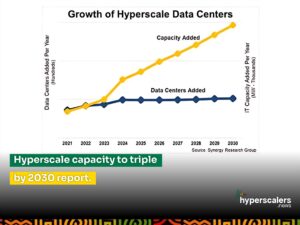
The global AI infrastructure boom presents Africa with an unusual opportunity. Computing capacity is being built at enormous scale, even as governments and companies worldwide reconsider where data, cloud services and AI workloads should reside. At the same time, growing resistance to data centre development in advanced markets could create openings elsewhere. In the US alone, about 120 data centre projects worth nearly $200 billion have reportedly been delayed or blocked this year, according to Data Center Watch, amid concerns ranging from power and water consumption to land use and community impact. For African markets able to offer reliable power, competitive construction costs, connectivity and a predictable investment environment, these pressures could strengthen the case for attracting a greater share of global data-centre investment.
Africa does not need to replicate the infrastructure scale of the United States or China to benefit. Capturing even a modest share of the next investment cycle could create new data centre markets, deepen fibre networks, stimulate power investment, expand cloud availability and provide the computing foundation for African AI applications.
But demographic potential will not be enough.
Africa has spent years demonstrating that the demand is coming. Now, it must prove that the continent can also be one of the world’s competitive places to build the infrastructure that serves it.