
Africa’s digital infrastructure story has often been told through the language of connectivity: more subsea cables, more fiber routes, more mobile broadband, more internet exchange points, and more last-mile access. But for Johnson Agogbua, Founder and Chief Executive Officer of Kasi Cloud Data Centers, the continent’s real challenge now sits deeper in the stack.
Africa is connected, but too much of its digital economy still runs elsewhere.
The applications are local. The users are local. The transactions are local. But the computing infrastructure, the cloud platforms, the storage environments, and the “brains” behind many digital services still sit outside the continent.
That, Agogbua argues, is the structural weakness Africa must now confront.
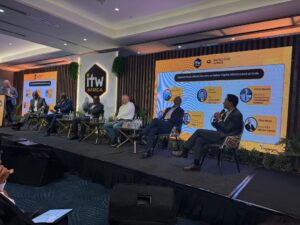
Speaking on Africa Hyperscalers Conversations – A Global View, Agogbua said Africa’s most persistent digital infrastructure problem is not simply fiber, spectrum, or even power, although power remains the most visible constraint. The deeper challenge, he said, is the absence of foundational infrastructure at sufficient scale.
“The most persistent challenge is the absence of foundational infrastructure, what I would call anchor infrastructure, that creates the conditions for everything else to follow,” he said.
For Agogbua, this view is shaped by more than three decades of global infrastructure experience. His career has included building the world’s largest commercial internet backbones at UUNET, the development of MPLS architecture, Facebook Connectivity’s work to expand high-speed internet access, and infrastructure architecture linked to Reliance Jio’s 4G/LTE network in India. Today, he is applying that experience to Nigeria through Kasi Cloud, a planned 100MW hyperscale data center campus in Lagos, with its first phase already launched.
Infrastructure must precede demand
When asked why he was building a 100MW data center in a market where single-digit megawatt facilities remain the standard, Agogbua said his conviction came from more than 30 years of building infrastructure across multiple continents.
He said that experience gave him a clear view of Africa’s digital infrastructure challenges because he had seen similar problems solved elsewhere. For him, the reason for taking on difficult infrastructure problems is straightforward: they exist, and they have to be solved.
Agogbua rejects the idea that Africa should wait for demand to fully mature before building at scale. In his view, the most consequential infrastructure projects often precede demand and help create the markets they eventually serve.
“At UUNET, we did not wait for demand for the global internet to emerge. We built a backbone and the demand followed,” he said. “At Reliance, Mukesh Ambani and his team did not ask whether India was ready for 4G before deploying infrastructure at massive scale.” Today, the network architected by Agogbua supports more than 500 million subscribers.
The lesson, he said, is that infrastructure can create demand when it is built with sufficient ambition and discipline.
“In both cases, infrastructure preceded demand, and the infrastructure itself created demand,” he said.
Nigeria, he argued, has been caught in the opposite pattern. Demand for digital services has grown rapidly, but the underlying infrastructure has lagged. Enterprises, fintechs, banks, and government agencies have therefore had to rely heavily on infrastructure hosted in Europe, the United States, and other offshore markets.
That has created multiple layers of leakage: foreign hosting costs, foreign exchange exposure, latency, weaker local control, and exposure to foreign legal jurisdictions.
“The result is a digital economy that is growing fast but leaking value at every layer,” Agogbua said.
This is the gap Kasi Cloud is trying to address. Its strategy is to build to the standard the market will require, not merely to the size of current visible demand.
“Build to hyperscale. Build AI-ready. Build with direct grid access and carrier-neutral connectivity, and trust that demand will follow, because the demand is already here. It just happens to be elsewhere,” he said.
Africa’s problem is now compute, not just connectivity
For years, Africa’s infrastructure debate has focused on access. That focus remains important, but Agogbua believes the next phase of the conversation must shift toward computation.
The continent has submarine cables. It has improved fiber infrastructure. It has 4G networks, emerging 5G deployments, internet exchange points, and growing data center investment. But the digital services Africans consume are still largely powered by infrastructure hosted outside the continent.
“The digital products and services we consume are powered by infrastructure whose brains reside outside the continent,” he said.
That creates latency problems, increases costs, limits enterprise scalability, and affects consumer experience.
This is especially important as artificial intelligence becomes central to the future of digital infrastructure. If Africa already has a small share of global data center capacity, Agogbua warned that its share of AI-ready compute is even smaller.
He believes Africa is not just importing clouds. It risks importing the next generation of intelligence infrastructure.
“We import our digital consumption,” he said. “That is what brought me back to Africa. That is what brought me back to Nigeria. That is why I live in Lagos. You have to be planted in the soil to till it.”
On the benefits of local infrastructure, Agogbua argued that aside from banks and fintechs, consumers and businesses would also feel the impact through better payment experiences, lower latency, and reduced transaction friction.
“It is a win for end users. It improves the digital experience. It is a win for enterprises that provide digital products. And for infrastructure providers, it is a challenge: can we deliver at standard? The answer is yes,” he said.

Kasi is a local execution layer, not a hyperscaler rival
One of the central questions around Kasi Cloud is how it fits into a market where many Nigerian enterprises already rely on Amazon Web Services (AWS), Microsoft Azure, Google Cloud, and other global platforms.
Agogbua does not frame Kasi as a direct competitor to global hyperscalers. Instead, he positions the company as enabling infrastructure: open access, carrier-neutral, hyperscale-ready, and built to support global cloud providers, local cloud providers, enterprises, and private cloud deployments.
“We are a local execution layer and a complement at the same time,” he said.
If an enterprise is committed to a global hyperscale cloud, Kasi can provide local execution infrastructure. If an enterprise works with a local cloud provider, Kasi can support that provider. If an enterprise runs its own private cloud, Kasi can provide the platform on which that infrastructure scales.
“We are not in competition with the global hyperscalers. In fact, it is the opposite. We are building the infrastructure for hyperscaling cloud and AI platforms,” Agogbua said.
This distinction matters. Africa’s cloud future is unlikely to be defined by a simple choice between local and global platforms. More likely, it will be hybrid: global cloud platforms, local hosting, private cloud, regulated workloads, latency-sensitive services, disaster recovery, and AI infrastructure coexisting within a stronger local ecosystem.
Kasi’s bet is that Nigeria needs the physical infrastructure layer that allows all of those models to work locally.
Nigeria’s Central Bank data localization as a demand signal
The Central Bank of Nigeria’s data localization directive has intensified the conversation about local infrastructure. The directive requires payment transaction data generated in Nigeria to be stored and managed locally, creating immediate implications for banks, fintechs, mobile money operators, switches, processors, and other licensed payment service providers.
For Agogbua, the directive is both a compliance burden and an infrastructure catalyst.
“It is unambiguously both,” he said. “But whether it becomes a burden or a catalyst depends entirely on when institutions start.”
Institutions that begin early, he argued, can use the directive to improve latency, reduce foreign exchange exposure, strengthen regulatory confidence, and redesign their infrastructure strategy. Those that delay may face a more difficult migration challenge later.
Agogbua also pushed back against the idea that Nigeria lacks local infrastructure providers. He pointed to the growing data center ecosystem, including Kasi, Equinix, Digital Realty, Rack Centre, Africa Data Centres, Open Access Data Centres, MTN, and others.
“The infrastructure is here,” he said. “Migrating payment transaction data to in-country infrastructure is a solvable engineering problem.”
The bigger issue is execution. Financial institutions must start early, cloud and data center providers must meet the required standards, and the broader ecosystem must coordinate around migration, security, resilience, interconnection, and compliance.
For the infrastructure industry, the CBN directive may be the clearest demand signal yet.
“It is the most consequential demand signal we have received to date,” Agogbua said.
AI is changing the data center blueprint
Kasi Cloud’s infrastructure roadmap has also been shaped by the rise of AI. Agogbua said the shift became clear several years ago when conversations moved from traditional enterprise rack density to much higher AI-era requirements.
Local enterprises and network operators were often discussing three kilowatts per rack or ten kilowatts per rack. But AI infrastructure conversations were already moving toward 30 kilowatts, 50 kilowatts, and eventually 100 kilowatts per rack.
“That is an order-of-magnitude shift,” he said.
The implication is that African data centers cannot be designed only for traditional colocation demand. AI workloads require more power density, advanced cooling, GPU-ready environments, stronger power architecture, and the ability to support significantly heavier compute loads.
Agogbua said Kasi responded by changing its approach to energy density, power architecture, and data center design. The company aligned its strategy around grid access, higher-voltage switching, and data halls capable of supporting significant capacity.
“Modern data centers must be able to solve for at least one order-of-magnitude increase in rack density. You must be able to move from 10 kilowatts per rack to 100 kilowatts per rack,” he said.
That, he added, is what Kasi has tried to prepare for: not only today’s cloud demand, but tomorrow’s AI infrastructure requirements.
Interconnection is its next layer
For any data center platform, interconnection is central to value. Agogbua said Kasi wants all subsea cables and metro providers to connect into the campus.
The company is already working on its first subsea cable connection into the campus and expects more operators to follow. At its foundry, Kasi already has subsea and metro connectivity, which it expects to migrate to the LOS1 campus.
The meet-me rooms have been designed to accommodate significant scale, including both four-post and two-post racks. The goal is to make the facility easy for operators, carriers, cloud providers, and network platforms to use.
“If you want to establish a point of presence in Kasi, now is the time,” Agogbua said. “Our doors are open.”
Can Africa host its digital future?
Agogbua’s argument ultimately goes beyond Kasi Cloud. It is about Africa’s position in the global digital economy.
If the continent continues to consume digital services hosted elsewhere, it will continue to leak value. Its enterprises will continue to absorb foreign latency and foreign costs. Its regulators will have limited visibility. Its AI ambitions will depend on offshore compute. Its digital sovereignty conversation will remain incomplete.
But if Nigeria and other African markets build foundational infrastructure at the right scale, the equation changes.
Connectivity growth can become compute growth. Regulatory directives can become infrastructure demand signals. Local data centers can become platforms for banks, fintechs, governments, AI companies, cloud providers, and enterprises. And Africa can begin to move from being a consumer of global digital infrastructure to a participant in its next phase.
For Nigeria, the timing is important. The market has a large digital population, deep fintech activity, expanding enterprise cloud adoption, a growing data center ecosystem, and new regulatory pressure around local data hosting.
The question is whether the country can convert those signals into execution.