

Africa has built more digital infrastructure over the past decade than at any point in its history, yet the continent continues to capture only a small share of global compute capacity as hyperscale and AI-driven investments accelerate elsewhere. That was the central message from a recent Africa Hyperscalers Conversations – A Global View session with Guy Zibi, Managing Partner at Xalam Analytics, which examined how the next phase of Africa’s digital infrastructure growth will depend less on connectivity expansion alone and more on where workloads are actually run.
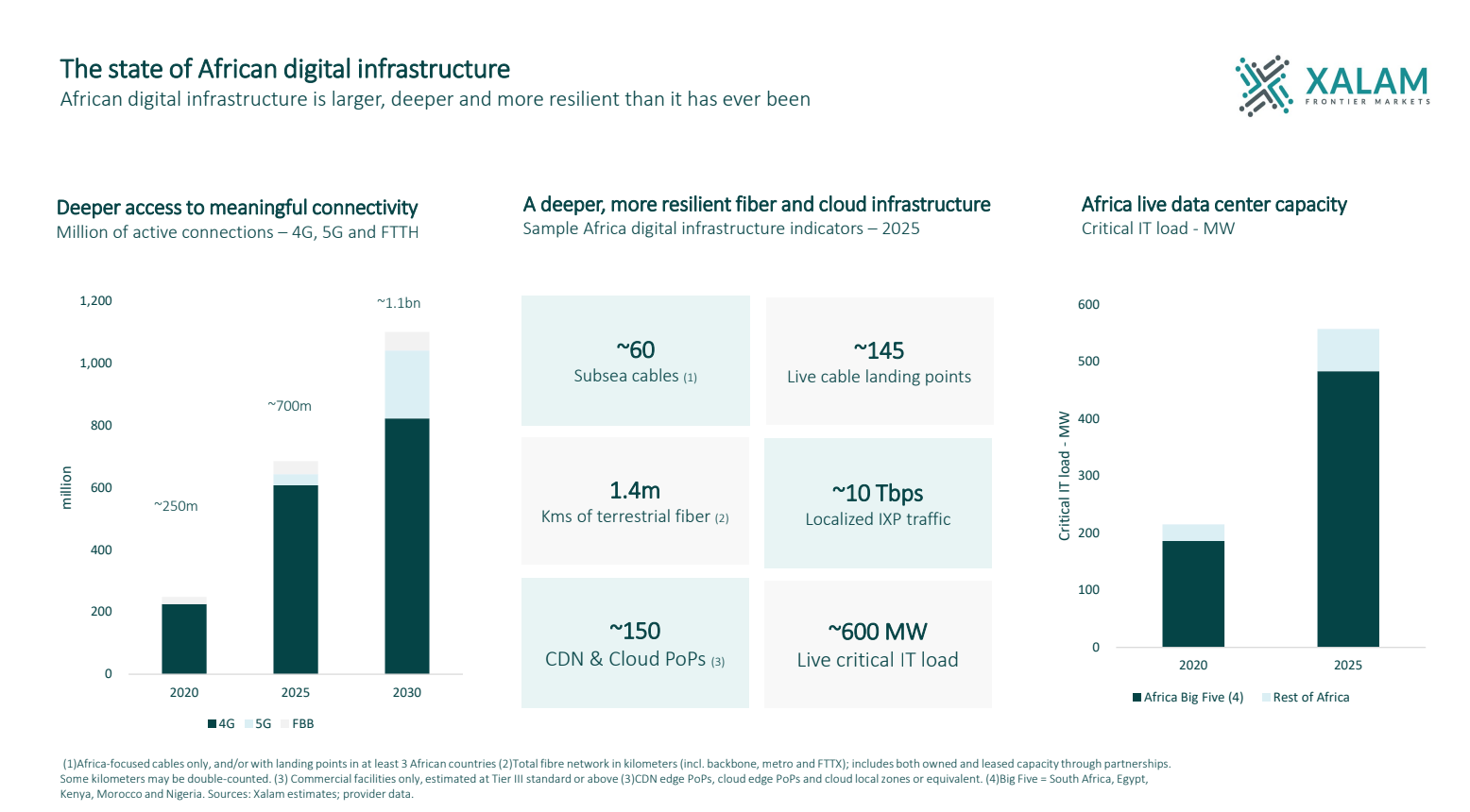
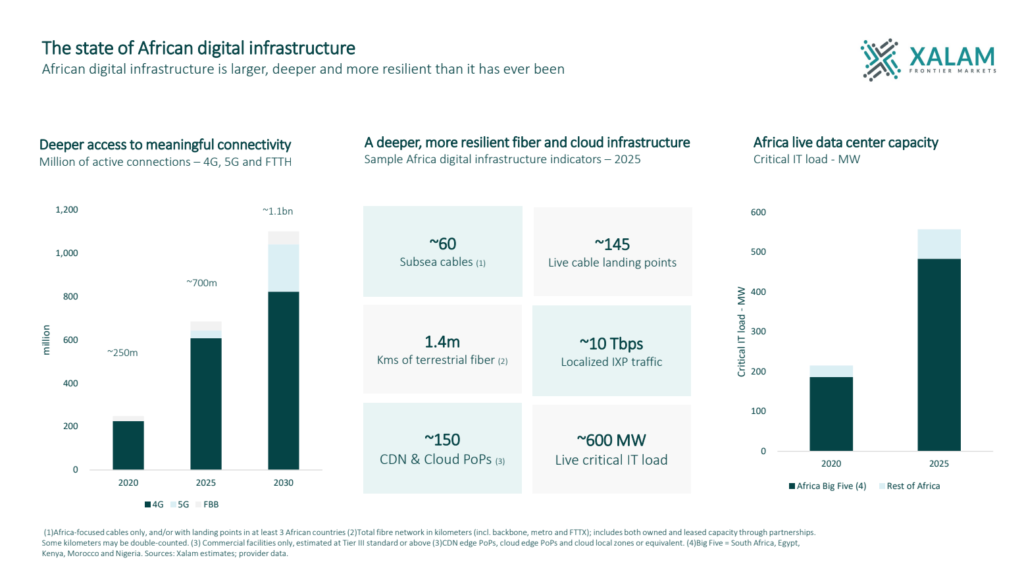
Africa today hosts roughly 500 to 600 megawatts of live data center IT capacity alongside about 60 subsea cables, 145 cable landing points, approximately 1.4 million kilometers of terrestrial fiber and around 150 cloud and content delivery network points of presence. Despite this progress, the continent still accounts for less than 1% of global compute capacity.
According to the discussion, the shift reflects a structural change in global infrastructure investment rather than a slowdown in African deployment. Hyperscale campuses and AI-driven compute clusters are increasingly being built at gigawatt scale in the United States, Europe, the Gulf and parts of Asia, expanding the global capacity base faster than emerging markets can match.
Zibi noted that the key distinction is between absolute infrastructure growth and relative global positioning. While Africa’s connectivity footprint has expanded significantly, the continent’s share of global public cloud usage remains around 0.3%, with roughly 0.2% of global AI compute resources located locally.
The session also highlighted the role of “meaningful connectivity” as a prerequisite for local compute market formation. Roughly 700 million Africans now use 4G, 5G or fiber-based broadband, creating a foundation for digital service expansion, though sustained workload concentration remains necessary before large-scale cloud regions typically emerge.
Public-sector digitization was identified as one of the most important drivers of early compute demand across emerging infrastructure markets. National identity systems, regulatory platforms and financial infrastructure were cited as examples of government workloads that can anchor local hosting ecosystems and reduce uncertainty for investors.
“When governments localize workloads, infrastructure follows,” Zibi noted.
The discussion further emphasized that hyperscaler expansion across Africa continues to follow demand maturity rather than infrastructure availability alone. While cloud capacity has expanded through edge deployments and partner facilities in multiple markets, full hyperscaler regions remain concentrated in a small number of hubs.
The Global Views session with Guy Zibi concluded that the next phase of Africa’s digital infrastructure development will depend on coordination across three systems: cloud demand formation, power availability and terrestrial fiber expansion. Without alignment across these layers, the pace of compute deployment is likely to remain uneven.
Despite the decline in relative global share, Zibi stressed that Africa’s infrastructure trajectory remains positive in absolute terms. The key question is whether improvements in connectivity can translate into sustained domestic workload growth capable of supporting larger-scale compute ecosystems across the continent.