

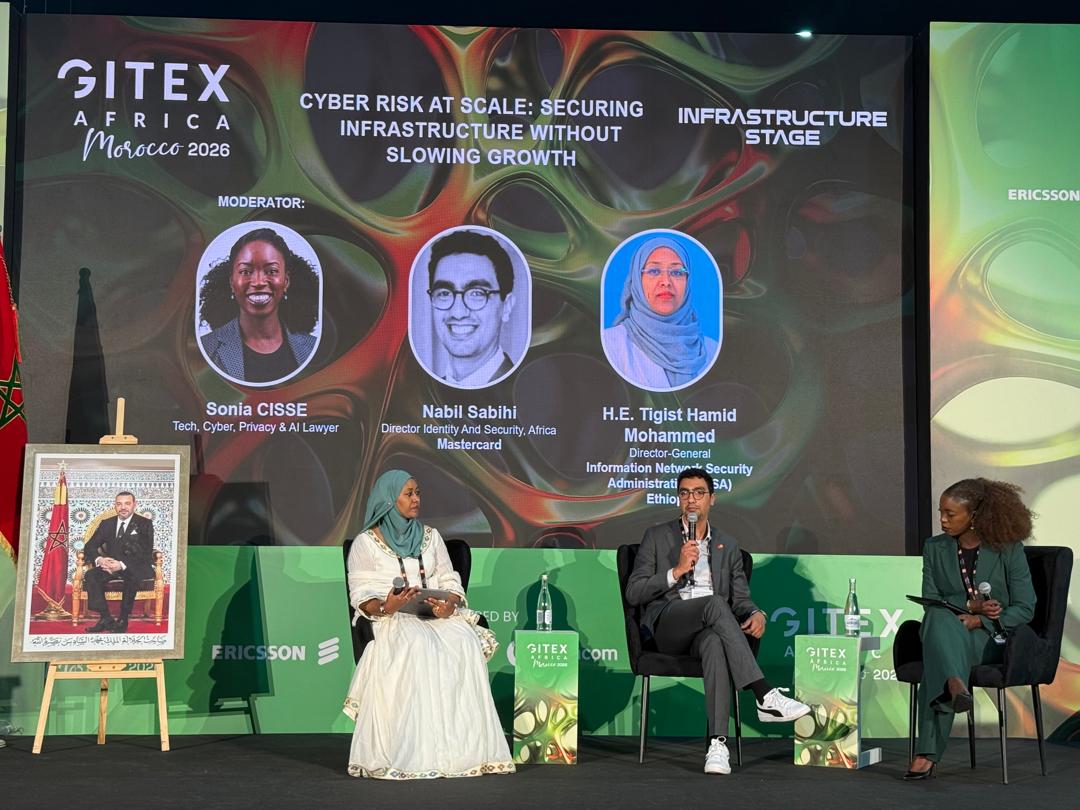
Cybersecurity is emerging as a foundational requirement for Africa’s digital infrastructure expansion rather than a compliance layer applied after deployment, speakers said during a panel session at GITEX Africa examining how governments and operators can secure rapidly scaling digital ecosystems.
Participants warned that cybersecurity must anchor Africa’s digital infrastructure strategy as financial platforms, digital identity systems, and public service architectures expand across the continent’s emerging digital economies.
With Africa’s digital economy projected to reach $1.5 trillion by 2030, panellists said cybersecurity must anchor Africa’s digital infrastructure strategy if governments are to sustain trust in digital public infrastructure and enterprise cloud adoption.
Sonia Cissé, Tech, Cyber and Privacy Partner at Linklaters and moderator of the session, said security-by-design must be embedded from the earliest stages of platform deployment rather than introduced later through regulatory enforcement.
“Cybersecurity must be integrated from day one,” she said.
She emphasized that cybersecurity must anchor Africa’s digital infrastructure strategy not only through technical safeguards but also through workforce development, institutional coordination, and structured collaboration between public and private actors.
Cissé also warned that African regulatory frameworks must reflect domestic operating realities rather than replicate external governance models that do not account for regional infrastructure constraints.
“Information sharing is mandatory if we want to be proactive,” she said.
H.E. Tigist Hamid Mohammed, Director-General of Ethiopia’s Information Network Security Administration, said cybersecurity is already being positioned as a core pillar of Ethiopia’s national infrastructure strategy alongside digital identity and public platforms.
She highlighted Ethiopia’s Fayda digital identity system as part of a broader effort demonstrating how cybersecurity must anchor Africa’s digital infrastructure strategy when governments scale trusted access to national services.
INSA has also introduced cybersecurity bootcamps designed to train specialists using sandbox environments that simulate real-world threats affecting critical infrastructure systems.
Mohammed said sustainable cyber resilience depends on coordinated institutional response frameworks and long-term investment in domestic technical capability.
Nabil Sabihi, Director of Identity and Security Solutions at Mastercard, said digital identity gaps remain one of the continent’s most significant structural cybersecurity challenges.
With roughly 60 percent of Africans lacking formal digital identity systems, authentication weaknesses continue to affect both financial inclusion and infrastructure security outcomes.
He said cybersecurity must anchor Africa’s digital infrastructure strategy by strengthening identity layers across financial platforms and public digital ecosystems while improving coordination between regulators responding to cross-border cyber threats.
As digital identity infrastructure, financial systems, and cloud platforms continue expanding across African markets, speakers agreed that cybersecurity is no longer a supporting function but a prerequisite for scaling trusted digital economies at continental scale
Related: Digital infrastructure, cloud and security in Africa